

Intravascular Ultrasound Catheter: From “Impressive Prototypes” to “Stable Mass Production” — How a CMO Closes the Manufacturing Gap
Share


In today’s era of precision-driven coronary interventions, intravascular ultrasound (IVUS) has become a critical tool for PCI physicians. Operating in a blood-filled environment, IVUS provides 360° cross-sectional imaging of the vessel lumen and vessel wall, supporting assessment of plaque morphology, lumen area, and stent apposition.
Coronary arteries remain the primary application for IVUS, typically in the 2.6–3.5F size range. Peripheral vascular adoption is also steadily increasing, with sizes commonly around 5–8.5F.
But for IVUS developers, the real inflection point is often not “making a prototype,” but answering this:
When orders scale from 10 units to 10,000 units and the line ramps up— why does image consistency fluctuate? Why does assembly yield drop rapidly? Why do rework hotspots concentrate at the distal end?
As a CMO deeply experienced in precision interventional catheter manufacturing, ECO sees the root challenge as:
How to systematically transform prototype-stage, experience-driven “craft work” into mass-production, engineering-grade capability that is verifiable, traceable, and repeatable.
I. What Exactly Makes IVUS Manufacturing Hard?
From a manufacturing division-of-labor perspective, a complete IVUS catheter can be broken down into four major modules:
・Distal assembly
・Transducer module
・Proximal assembly
・Proximal handle
Among them, the transducer module is the core of IVUS, involving acoustic design, micromachining, and critical processes—and is typically developed and manufactured in-house by the IVUS company.
ECO focuses on precision manufacturing and consistent delivery of the other two modules—distal and proximal assemblies—and supports two delivery levels:
・Part level: distal parts, proximal parts
・Subassembly level: distal subassembly, proximal subassembly (modules consolidated from multiple parts via key processes, ready to enter the customer’s final assembly)
Through tiered delivery from “parts → subassemblies,” we front-load and compress mass-production uncertainty into controlled processes as early as possible.
Challenge 1: Distal assembly — the triangle trade-off of “flexibility, pushability, and coaxiality”
The distal section must be flexible enough to navigate tortuous vessels, while still maintaining pushability/trackability and structural stability. This typically depends on multi-material, multi-segment matching and forming—enabled by material combinations, tapering, and thermal forming process-window control.
In mass production, minor variations in thermal behavior, shrink-back/rebound, and wall-thickness distribution can be amplified into significant dispersion in distal performance.
Challenge 2: Imaging window — balancing “acoustic transparency” and “mechanical support”
The outer sheath in the distal imaging-window region must deliver acoustic transparency and stability, while also providing necessary support, sealing, and fatigue resistance. Material selection and structural design directly influence image consistency and reliability.
Clearance control is equally critical: if the gap between the inner core and outer sheath is too large or too small, if air evacuation during assembly is insufficient, or if bubbles/contamination are introduced during processing, the result may be imaging artifacts or unstable image consistency.
Challenge 3: Bonding — moving from “expert dispensing” to “replicable processes”
Whether it’s joining structures at the distal window or creating a stress transition between the proximal assembly and handle, IVUS assembly relies heavily on bonding/joining processes. Heterogeneous bonding across multi-material systems demands tight control over surface preparation, adhesive systems, dispense volume, cure windows, aging behavior, and chemical resistance.
In prototyping, teams can often “tune it until it works.” In mass production, however, typical failures include: adhesive-volume variability, overflow contamination, under-curing/over-curing, microcracks, strength fluctuations, and long-term drift after aging—directly reducing yield and increasing reliability risk.
ECO standardizes these “black-box processes”: Through standardized surface pretreatment, dispensing parameters (pressure/time/needle gauge), cure profiles, and in-process acceptance criteria, we shift bonding from “operator-dependent” to “data-driven,” keeping critical interfaces consistent in strength and stability during mass production.
II. ECO POLYMER's Exclusive Solution
A professional CMO should not be merely a “build-to-print shop.” Instead, it should be an engineering partner that translates design intent into a scalable production route. Therefore, as a specialized CMO, ECO locks "uncertainty" into the process window, delivering not only production capacity, but also a manufacturing system that can ramp, can be traced, and can be validated.
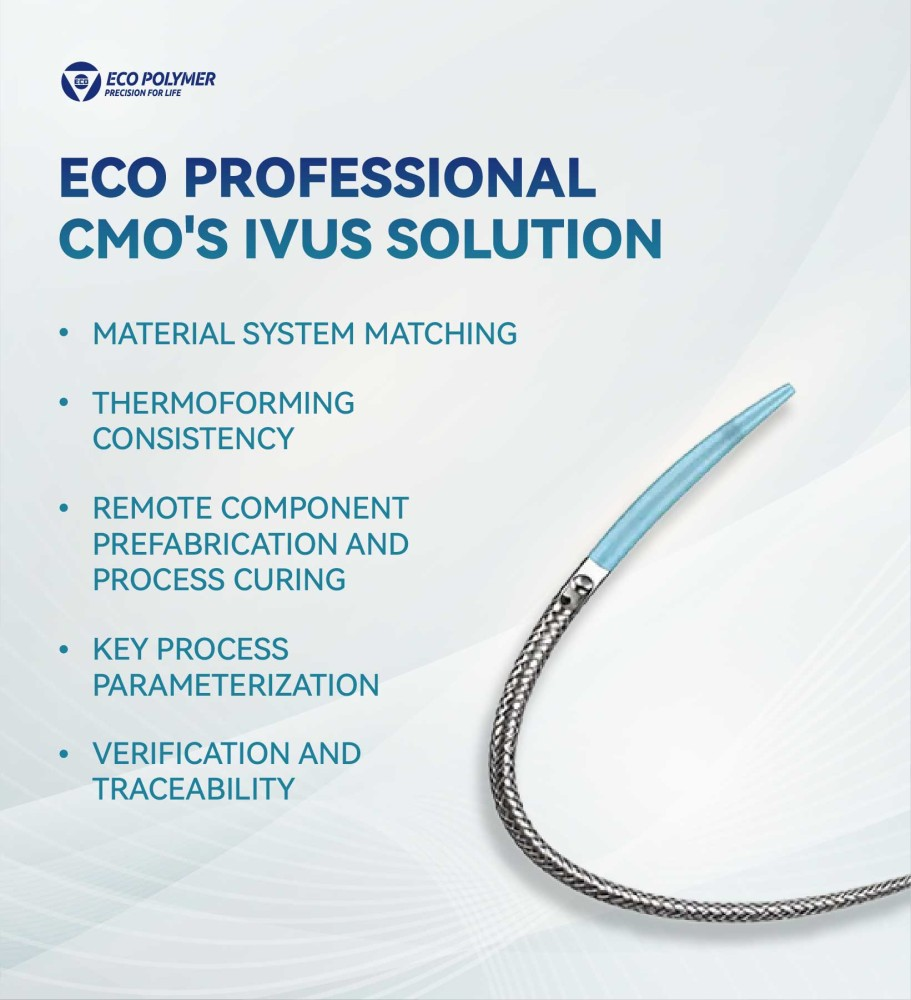
1) Upgrading from “dimensionally acceptable” to “repeatable process behavior”
R&D often focuses on final dimensions; mass production focuses on whether the same process behaves consistently across shifts, batches, and operators.
・Material-system matching: not “stacking materials,” but locking the materials and forming window around the customer’s targets.
・Thermoforming consistency: thermoforming is often the “hidden switch” for yield in distal windows and transition zones—the key is making shrink-back behavior predictable and verifiable as process capability.
2) From “qualified parts” to “system-level subassembly delivery”
IVUS most often fails at the subassembly stage, because stacked variables grow exponentially.
・Distal subassembly pre-build & process consolidation: ECO solidifies the most sensitive distal performance factors (flexibility/coaxiality/transition behavior) into deliverable subassemblies, reducing variable risk when the customer takes the product into their own final assembly line.
3) From “feel” to “data”: an engineering-grade shift
Experience matters in prototyping: process capability matters in production.
・Parameterizing critical steps: define parameter boundaries and acceptance criteria for dispensing, curing, heat shrink, tapering, and other key processes.
・Validation and traceability: provide necessary process validation (IQ/OQ/PQ) and traceability from raw-material lots to finished assembly, supporting registration and audit requirements.
III. You Set the Target — ECO Builds the Path
In the IVUS arena, your core competitiveness lies in transducer technology, algorithms, and clinical insight. Entrusting the precision manufacturing and consistent delivery of distal assemblies, proximal assemblies, and proximal handles to a professional CMO is not merely cost optimization—it is a strategic move to control scale-up risk and secure delivery certainty.
If you are (or preparing to) move an IVUS program into clinical stage or mass production, we welcome you to engage ECO with your requirements:
・Target sizes: Coronary artery or peripheral IVUS dimensions, etc.
・Performance priorities: Pushability, Flexibility, Coaxiality, Window Stability
・Delivery scope: Distant or proximal components/assemblies, or those including proximal handles, etc.
・Process constraints: Heat shrink temperature window, assembly cycle time, cleanliness/cleanliness requirements, etc.
ECO’s goal is clear: to turn IVUS manufacturing from an uncertainty-filled “art” into a data-driven “science.”
