

The most difficult part of purchasing FEP heat shrink tubing is not choosing the specifications, but ensuring "consistent heat shrink ratio in mass production"—this is where the yield rate differences begin.
Share


In manufacturing processes such as balloon catheters, microcatheters, guidewire sheaths, instrument coating protection, insulation, and component encapsulation, FEP heat-shrink tubing is often used as an "auxiliary material." However, for medical device manufacturers, it is often involved in the "last mile" of critical processes: completing encapsulation, shaping, and protection within a controlled temperature window. If the shrinkage behavior deviates from expectations, the result is usually not just a "slightly imperfect appearance," but rather coating blistering/sagging, composite misalignment, wall thickness variations, edge curling, rework, and ultimately, delays in delivery and increased costs.
From the demand side, FEP heat shrink tubing has established a clear niche market in the medical field. The global medical market size for FEP heat shrink tubing is approximately $145 million in 2024 and is projected to grow to $208 million by 2029, with a compound annual growth rate (CAGR) of 7.4%. North America is the largest market, but the Asia-Pacific region is the fastest-growing market. Currently, FEP heat shrink tubing with a shrink ratio of 1.6:1 holds the largest market share and is expected to maintain its dominant position and be the fastest-growing segment between 2024 and 2029. These trends are driven by the long-term trend of interventional and minimally invasive medical devices becoming increasingly smaller, more precise, and suitable for consistent mass production.
The value of FEP heat shrink tubing
FEP (Fluorinated Ethylene Propylene Copolymer)It possesses excellent chemical stability and thermoplastic processability. When processed into heat-shrinkable tubing, it can shrink from its pre-expanded form to the target size at a specific temperature, achieving integrated functions of wrapping, shaping, and protection.
For manufacturers, its value typically lies in three types of capabilities:
1. "Clearly visible" visual process control
FEP heat shrink tubing offers high transparency, facilitating observation of the internal structure, alignment, and encapsulation status. This is particularly beneficial in microcatheters and double-layer/multi-layer composite structures, significantly improving process verification efficiency and reducing rework caused by "invisibility."
2. Consistent molding with minimal shrinkage.
The key challenge in medical devices is never simply whether they can shrink, but rather whether every roll and every batch shrinks consistently: the consistency of the shrinkage ratio, the shrinkage temperature window, and the longitudinal shrinkage and end-forming determine whether the process can be replicated in mass production.
3. Consistent molding with minimal shrinkage.
FEP's low friction and low adhesion properties make it less likely to introduce additional variables during encapsulation, protection, and shaping. Common shrinkage ratios include 1.3×, 1.6×, and 2×, with a typical shrinkage temperature range of 205–240℃ (specific values still require verification based on the customer's material system), making it compatible with various catheter material combinations.
Common applications include: composite tube processing, guide wire sheathing, component coating, waterproofing and protection, instrument coating protection, insulation, wear/corrosion protection, and encapsulation.
"Delivery pain points" of FEP heat shrink tubing
Many procurement problems don't surface on the day the materials arrive, but rather become apparent during the customer's mass production ramp-up phase.
The typical pain points fall into three main categories:
Pain point 1: The samples were acceptable, but the heat shrinkage ratio of the mass-produced product showed fluctuations in "shrinkage behavior" (which is the most critical issue). The key to FEP heat shrink tubing is not the static dimensions, but the dynamic shrinkage behavior.
Fluctuations in mass production often manifest as:
・After shrinkage, the inner diameter deviates, leading to insufficient or excessive pressure on the inner layer;
・Longitudinal shrinkage instability leads to edge warping and stress concentration at the ends;
・Differences in transparency/haze between batches affect alignment determination;
・Thermal window offset can lead to surface ripples, localized weak points, and even blistering defects.
Pain point 2: Tiny tolerance deviations are amplified into rework issues by the "composite/coating process."
During the compounding and coating processes, the inner diameter, wall thickness, roundness, and surface micro-defects of the heat-shrinkable tubing are "amplified":
・Wall thickness variations → Uneven heat transfer and shrinkage pressure → Decreased consistency in appearance and structure;
・Ellipticity → Uneven contact → Increased probability of defects at the composite interface;
・Surface defects/scratches → become crack initiation points → increasing the risk of tearing or leakage.
Pain point 3: Delivery time and supply stability affect production line rhythm.
Heat shrink tubing is often on the critical path of multi-stage manufacturing processes. If delivery times become unpredictable, the range of available sizes is incomplete, or there are temporary supply disruptions, the production line will either have to use a lower-grade substitute (triggering re-validation) or reschedule production (increasing hidden costs).
ECO "FEP Dedicated Solutions"
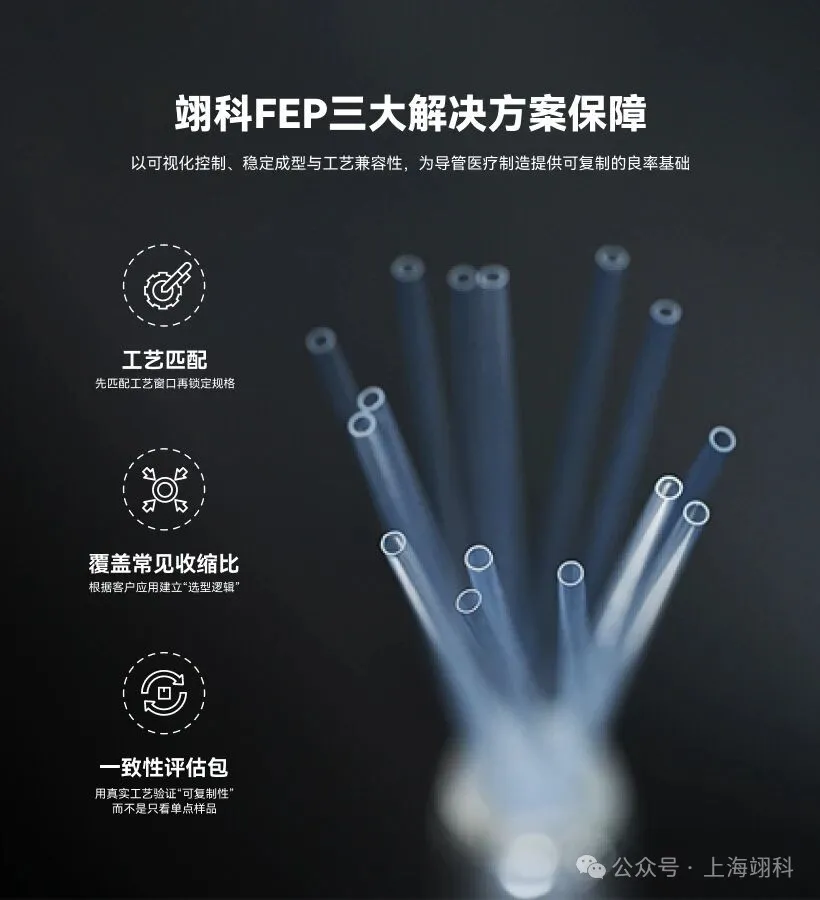
Option 1: Contraction condition matching
Different customers use different heating methods, line speeds, fixtures, and substrate combinations, so heat shrink tubing of the same specifications may perform completely differently on different production lines. During the project implementation phase, ECO prioritizes working closely with the customer's actual process to jointly confirm the optimal solution.
・Target shrinkage ratio and effective thermal window (temperature range, shrinkage rate, and stability)
・Longitudinal retraction and end forming (to prevent warping and stress concentration)
・Impact on the inner layer material (reducing risks such as blistering, warping, and deformation)
・By first matching the process window and then locking down the specifications, we reduce subsequent trial-and-error and verification cycles.
Option 2: Specifications Library and Selection Recommendations – Accelerate implementation and reduce replacement costs with "typical specifications."
ECO can provide suggested specifications covering common shrinkage ratios (such as 1.3×/1.6×/2× (under development)) and wall thickness ranges, and establish a "selection logic" based on customer applications.
・Which scenarios prioritize transparency/low haze to improve alignment efficiency?
・Which scenarios prioritize consistent wall thickness and shrinkage to ensure consistent encapsulation pressure?
・Providing feasible ranges for possible alternative specifications in advance facilitates quick switching in the event of supply disruptions and shortens the re-validation cycle.
This standardizes procurement decisions and makes the supply chain more resilient.
Option 3: Consistency Evaluation Package – verifying "reproducibility" with real-world processes, rather than just looking at single samples.
Many mass production problems do not stem from incoming material dimensions, but rather from process variations between batches that are amplified by the manufacturing process. ECO can provide a more accurate assessment path closer to mass production by working with the customer's key processes (compounding/coating protection/shaping), for example:
・Batch consistency verification focusing on key dimensions (ID/OD/wall thickness/roundness)
・Standard samples for evaluating transparency/haze and surface defects (facilitating consistent implementation in the field)
・Develop verification focus points and sample configuration recommendations specifically for the defect modes that are most critical to the customer (e.g., blistering, sagging, waviness, edge lifting, etc.).
The goal is to reduce the probability of problems only becoming apparent during mass production, thereby reducing rework and scrap costs.
Solution 4: Traceable Delivery and Change Control – Ensuring certainty in verification, auditing, and continuous supply.
Medical device clients often require different levels of validation and documentation closure at various stages of a project. ECO can provide quality delivery support tailored to each project phase:
・Certificate of Analysis (COA), batch traceability, and critical release items (supporting internal verification and incoming material management)
・Process Change Notification (PCN) mechanism: A system for evaluating and notifying stakeholders of changes to raw materials, process parameters, and equipment/fixtures, reducing the risk of unexpected variations.
・Regarding supply chain stability strategies for the mass production phase, the goal is to minimize the impact of delivery time uncertainties on production line rhythm.
ECO delivers not just individual FEP heat shrink tubes, but a complete solution including a reproducible shrinking process and traceable production consistency that can be implemented on the customer's production line. In the era of mass production, the best strategy for purchasing FEP heat shrink tubes is not to "find the cheapest," but to find a manufacturing partner that can consistently deliver reliability and certainty.
